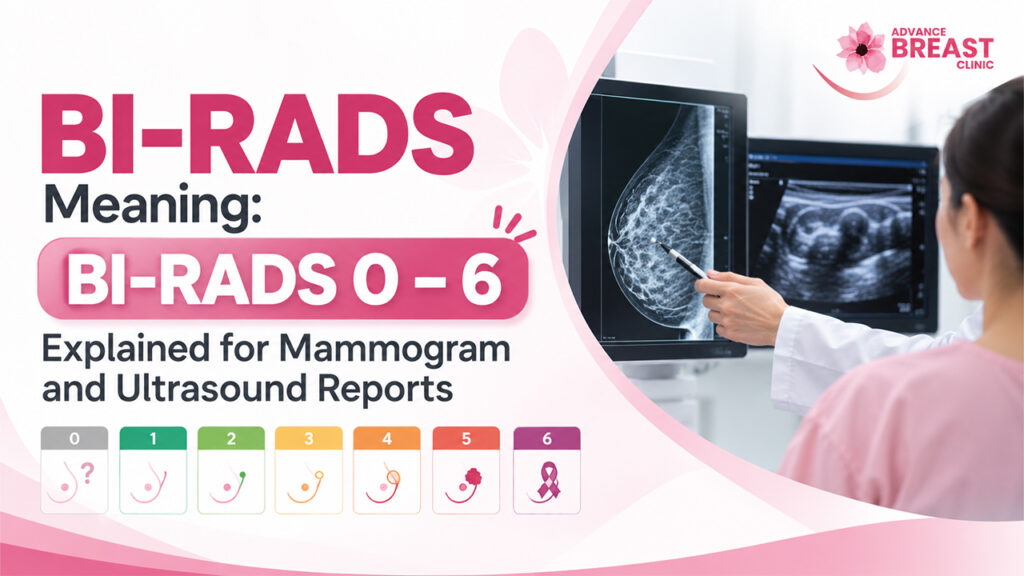
BI-RADS Meaning: BI-RADS 0–6 Explained for Mammogram and Ultrasound Reports
If your mammogram or breast ultrasound report contains a number from BI-RADS 0 to BI-RADS 6, that number summarizes how the radiologist assessed the breast-imaging finding and what usually needs to happen next.
The most important point about BI-RADS meaning is that a BI-RADS number is not the same as a cancer stage and, except for BI-RADS 6, it is not a diagnosis of breast cancer. BI-RADS 1 and 2 are reassuring assessments, BI-RADS 3 is probably benign, BI-RADS 4 is suspicious and commonly leads to biopsy, BI-RADS 5 is highly suggestive of malignancy, and BI-RADS 6 refers to cancer that has already been confirmed by biopsy. BI-RADS 0 means the examination is incomplete and more imaging or comparison with prior images is needed.
This guide explains what each category means, why BI-RADS 3, 4 and 5 often cause confusion, how mammogram and breast ultrasound reports use the system, and what to look for in the recommendation section of your report.
Last updated: September 14, 2026.
What Does BI-RADS Mean?
BI-RADS stands for Breast Imaging Reporting and Data System. It was developed by the American College of Radiology to create standardized terminology, assessment categories and recommendations for breast imaging.
The current ACR BI-RADS v2025 framework covers mammography, ultrasound and breast MRI and is designed to help radiologists communicate breast-imaging findings clearly and consistently.
A BI-RADS assessment therefore answers a practical question:
Based on what the radiologist sees, how should this breast-imaging finding be classified, and what is the appropriate next step?
That next step might be:
- returning to routine screening;
- obtaining additional mammogram views;
- comparing the examination with older images;
- having a targeted breast ultrasound;
- repeating imaging after a short interval; or
- obtaining tissue through a biopsy.
BI-RADS should therefore be read as part of a clinical pathway, not simply as a score where a higher number automatically tells you your diagnosis.
BI-RADS Categories 0–6 at a Glance
The following table gives the practical meaning of each assessment category.
| BI-RADS | Meaning | Approximate concern for malignancy | Typical next step |
|---|---|---|---|
| 0 | Incomplete assessment | Not assigned | Additional imaging and/or comparison with previous images |
| 1 | Negative | Essentially no suspicious imaging finding | Routine screening as appropriate |
| 2 | Benign finding | Benign | Routine screening as appropriate |
| 3 | Probably benign | No more than about 2% | Short-interval imaging follow-up |
| 4 | Suspicious abnormality | More than 2% but less than 95%; subdivided into 4A–4C | Tissue diagnosis/biopsy generally recommended or considered |
| 5 | Highly suggestive of malignancy | At least about 95% | Tissue diagnosis and appropriate clinical action |
| 6 | Known biopsy-proven malignancy | Cancer already established by prior biopsy | Treatment planning, staging/response assessment or other appropriate management |
Current American Cancer Society guidance describes BI-RADS 3 as having no more than a 2% likelihood of cancer, category 4 as covering a broad suspicious range, and category 5 as having at least a 95% likelihood of malignancy. Category 6 is reserved for a lesion already demonstrated to be cancer by biopsy.
The percentages describe how the imaging assessment category is defined. They should not be used to calculate an individual person’s personal probability of cancer without clinical context.
What Does BI-RADS 0 Mean?
BI-RADS 0 means the breast-imaging assessment is incomplete. It does not mean that breast cancer has been diagnosed.
The radiologist needs more information before assigning a final assessment.
This commonly happens after a screening mammogram when an area needs to be looked at more closely. The next step could include additional mammogram views, magnification, spot compression, targeted ultrasound or comparison with previous examinations.
For example, a radiologist may see an area of asymmetry on a screening mammogram but may not be able to tell from the initial images whether it represents overlapping normal tissue or a true abnormality.
The appropriate response is therefore not to interpret BI-RADS 0 as “cancer.” It means:
“The examination is not yet complete enough for a final BI-RADS assessment.”
Why previous mammograms matter
Comparison is an important part of mammographic interpretation.
An area that appears concerning on one examination may become much easier to interpret when the radiologist can see that it has been unchanged on previous mammograms. RadiologyInfo recommends making prior images available because comparison may affect what the radiologist recommends.
If you had earlier mammograms at another hospital or imaging center, ask whether the interpreting radiologist needs those images.
What Does BI-RADS 1 Mean?
BI-RADS 1 means the imaging assessment is negative.
In practical terms, the radiologist did not identify a suspicious mass, abnormal distortion or other finding requiring additional evaluation on that examination. The American Cancer Society describes category 1 as a normal result with no new or abnormal finding identified.
For someone undergoing routine screening, the usual recommendation is to continue screening according to the schedule appropriate for their age and individual breast-cancer risk.
However, a reassuring imaging result should not be used to dismiss a clinically concerning new breast symptom without appropriate evaluation.
Imaging is one component of breast assessment. A new lump, skin change, nipple change or persistent focal symptom may still require clinical review even when one imaging examination is reassuring.
What Does BI-RADS 2 Mean?
BI-RADS 2 means the radiologist sees a finding that is confidently benign, or noncancerous.
Examples may include clearly benign calcifications, certain benign masses, lymph nodes or recognizable changes from a previous procedure.
The important difference between BI-RADS 1 and BI-RADS 2 is therefore not that one is “safer” than the other.
Instead:
- BI-RADS 1: no relevant abnormal imaging finding is identified.
- BI-RADS 2: a finding is present, but its imaging appearance is benign.
Both generally return the patient to routine screening when screening is otherwise appropriate.
This distinction also helps future radiologists. Documenting a benign finding means it can be recognized on later imaging rather than repeatedly treated as an unexplained abnormality.
What Does BI-RADS 3 Mean?
BI-RADS 3 means “probably benign.” The finding has a very low likelihood of malignancy—no more than about 2%—but it should be monitored to confirm that it remains stable.
This category often worries patients because it sits between the clearly benign categories and the suspicious categories. But “probably benign” is not another way of saying “probably cancer.”
The logic behind BI-RADS 3 is different.
The imaging appearance is sufficiently reassuring that an immediate biopsy may not be necessary, but the radiologist wants documented stability over time before considering the finding definitively benign.
What happens after a BI-RADS 3 result?
Short-interval follow-up imaging is commonly recommended.
The American Cancer Society notes that repeat imaging may be performed within roughly 6–12 months, followed by further surveillance until stability has been demonstrated for an appropriate period, often around two years. The exact timing depends on the imaging finding and the radiologist’s recommendation.
A report may therefore say something such as:
“Probably benign finding. Six-month follow-up ultrasound recommended.”
That recommendation is an important part of the result. Do not focus only on the number and ignore the follow-up interval.
Does BI-RADS 3 require biopsy?
Not automatically.
The purpose of category 3 is often to allow careful imaging surveillance when a finding has a sufficiently reassuring appearance, helping avoid unnecessary biopsy while still checking for meaningful change.
However, management can change if:
- the finding changes during surveillance;
- clinical examination is concerning;
- the imaging finding does not adequately explain the patient’s symptom; or
- other clinical factors alter the assessment.
The safest interpretation is therefore:
BI-RADS 3 = probably benign, but follow-up matters.
What Does BI-RADS 4 Mean?
BI-RADS 4 means that the imaging finding is suspicious enough that tissue diagnosis should generally be considered or recommended. It does not mean cancer has already been confirmed.
Category 4 is deliberately broad. That is why radiologists often divide it into BI-RADS 4A, 4B and 4C.
Current American Cancer Society guidance summarizes the subcategories as follows:
| Category | General level of suspicion | Approximate malignancy range |
|---|---|---|
| BI-RADS 4A | Low suspicion | >2% to ≤10% |
| BI-RADS 4B | Moderate suspicion | >10% to ≤50% |
| BI-RADS 4C | High suspicion | >50% to <95% |
These ranges show why simply saying “BI-RADS 4” is not enough to understand how suspicious the imaging appearance is.
Does BI-RADS 4 mean breast cancer?
No. BI-RADS 4 means the finding cannot be confidently classified as benign and is suspicious enough to justify tissue assessment.
A biopsy is performed because imaging has limits. Mammography and ultrasound can show characteristics associated with benign or malignant disease, but they cannot reliably determine the tissue diagnosis of every suspicious lesion.
That distinction is essential:
Imaging identifies and classifies the abnormality. Pathology from tissue sampling determines what the abnormality actually is.
Advance Breast Clinic’s diagnostic pathway includes breast ultrasound, FNAC, core biopsy and ultrasound-guided sampling where clinically indicated.
For more information about the clinic’s diagnostic pathway, see its breast diagnostic services.
What does BI-RADS 4A mean?
BI-RADS 4A means the lesion has low suspicion for malignancy but is suspicious enough that biopsy is usually appropriate.
The commonly cited malignancy range is greater than 2% and no more than 10%.
This is important psychologically as well as medically. A BI-RADS 4A result should not be interpreted as a cancer diagnosis merely because biopsy has been recommended.
Biopsy is recommended precisely because the imaging does not provide a definitive answer.
What does BI-RADS 4B mean?
BI-RADS 4B describes an intermediate or moderate level of suspicion.
The commonly used range is greater than 10% and no more than 50%.
Because that range remains broad, the report’s description of the actual finding also matters.
For example, the radiologist may discuss a mass’s shape, margins, orientation or other characteristics, or may describe suspicious mammographic calcifications or architectural distortion.
Patients should therefore read the impression and recommendation, not simply search the category number in isolation.
What does BI-RADS 4C mean?
BI-RADS 4C means the abnormality has a high level of suspicion for malignancy, but the appearance is not sufficiently characteristic to place it in category 5.
The commonly used range is greater than 50% but less than 95%.
Prompt diagnostic follow-up is important.
However, even BI-RADS 4C remains an imaging assessment. A tissue diagnosis is needed before an unbiopsied lesion should be treated as confirmed breast cancer.
What type of biopsy may be performed?
The appropriate procedure depends on the lesion, imaging modality and clinical circumstances.
When an abnormality is visible on ultrasound, real-time ultrasound may be used to guide a sampling needle accurately into the target. Advance Breast Clinic describes both FNAC and core biopsy within its diagnostic services, while its breast-ultrasound guidance explains the role of ultrasound-guided sampling.
Read more about how breast ultrasound evaluation fits into the diagnostic pathway.
What Does BI-RADS 5 Mean?
BI-RADS 5 means the imaging findings are highly suggestive of malignancy. The category is associated with at least about a 95% likelihood of malignancy, and tissue diagnosis is strongly indicated when cancer has not already been confirmed.
This category should be taken seriously and followed up promptly.
But there is still an important distinction between:
“Highly suggestive of malignancy on imaging”
and
“Breast cancer confirmed by pathology.”
For someone who has not yet had a biopsy, BI-RADS 5 is not the same thing as a final pathology diagnosis.
The biopsy also provides information that imaging alone cannot provide and that may influence treatment planning.
What Does BI-RADS 6 Mean?
BI-RADS 6 means the abnormality has already been proven to be malignant by a previous biopsy.
This is fundamentally different from categories 0–5.
In category 6, the question is no longer whether the imaging finding is likely to be cancer. Cancer has already been established through tissue diagnosis.
Imaging may then be performed for reasons such as assessing the known disease or monitoring response to treatment.
Does BI-RADS 6 mean stage 6 breast cancer?
No. There is no relationship between the number 6 in BI-RADS and the stage of breast cancer.
BI-RADS and cancer staging answer completely different questions.
BI-RADS describes an imaging assessment.
Cancer staging describes how extensive a confirmed cancer is and uses a separate clinical and pathological framework.
A BI-RADS 6 result therefore means:
“This imaging finding corresponds to cancer already proven by biopsy.”
It does not mean “stage 6 cancer.”
Can the Same BI-RADS System Be Used for Mammograms and Breast Ultrasound?
Yes. BI-RADS assessment terminology is used for mammography, breast ultrasound and breast MRI, although how the imaging finding is described and how the recommendation is implemented can vary by modality and clinical situation.
That means a patient might receive:
- BI-RADS 2 after mammography;
- BI-RADS 3 after targeted ultrasound;
- or a BI-RADS 4 assessment after an abnormality is characterized more fully.
The relevant question is not only “What number did I get?”
Also ask:
“Which finding received that assessment, on which examination, and what does the radiologist recommend next?”
Mammogram reports
A mammogram report generally contains sections describing the examination, clinical history, comparisons, technique, findings and final impression. The impression usually contains the final assessment and recommended next step.
If you want more background about the test itself, Advance Breast Clinic has a detailed guide to mammography in Nepal.
Breast ultrasound reports
A breast ultrasound may describe characteristics such as whether a lesion is cystic or solid, its size, shape, orientation, margins and relationship with surrounding breast tissue.
Ultrasound can help characterize a breast mass, but it does not replace mammography in every patient and does not provide a definitive tissue diagnosis for every suspicious lesion.
This is why a suspicious ultrasound finding may lead to mammography, biopsy or another investigation depending on age and clinical context.
BI-RADS 0–6 Is Not the Same as Breast Density A–D
This is one of the most common sources of confusion when reading a mammogram report.
A mammogram can contain two different types of BI-RADS information:
- BI-RADS assessment category: 0–6
- Breast-density category: A–D
They do not measure the same thing.
The assessment number summarizes how the imaging finding is classified and what management is appropriate.
The density letter describes how much fibroglandular tissue is visible relative to fat on the mammogram. The American Cancer Society notes that BI-RADS breast density is classified into four groups, A through D.
Therefore:
“Density category C” does not mean BI-RADS 3.
And:
“Density category D” does not mean BI-RADS 4.
Advance Breast Clinic’s separate guide explains what dense breasts mean and why density can influence mammographic interpretation.
How Should You Read a Mammogram or Breast Ultrasound Report?
Instead of searching every medical term individually, read the report in a structured order.
Step 1: Identify the type of examination
First determine whether the report is for:
- screening mammography;
- diagnostic mammography;
- targeted breast ultrasound;
- breast MRI; or
- another breast-imaging examination.
The reason for the test affects how the result should be interpreted.
A screening mammogram is performed in someone without a current breast symptom for early detection, while diagnostic imaging investigates a symptom or finding that needs closer evaluation.
Step 2: Read the comparison section
Look for whether the radiologist compared the examination with previous images.
Previous imaging can reveal whether a finding is new, changing or stable. RadiologyInfo specifically notes that prior mammograms may affect what the radiologist recommends.
If the report says previous images are unavailable, find out whether they should be obtained.
Step 3: Read the findings
This section describes what the radiologist observed.
Depending on the examination, terms might include:
- mass;
- cyst;
- calcification;
- asymmetry;
- architectural distortion;
- lymph node;
- breast density; or
- postoperative change.
Do not try to diagnose yourself from one descriptive word. The significance comes from how those characteristics fit together.
Step 4: Find the final BI-RADS assessment
This gives the radiologist’s overall classification of the relevant finding.
If multiple areas were evaluated, the report may describe more than one finding or assessment. RadiologyInfo notes that individual lesions may receive BI-RADS assessments in breast-imaging reports.
Pay particular attention to the final impression.
Step 5: Read the recommendation
This is arguably the most actionable part of the report.
It may say:
- routine screening;
- additional diagnostic views;
- targeted ultrasound;
- short-term follow-up;
- comparison with old imaging;
- biopsy; or
- specialist evaluation.
The recommendation converts the imaging interpretation into a next step.
A simple report-reading framework
When reading a mammogram or breast ultrasound report, ask four questions:
1. What did the radiologist see?
2. What BI-RADS category was assigned?
3. What does that category mean in this particular report?
4. What action did the radiologist recommend?
That sequence is far more useful than searching the number alone.
Can a BI-RADS Category Change?
Yes. A BI-RADS assessment can change when additional information becomes available.
A BI-RADS 0 examination, for example, is specifically incomplete. After additional views, targeted ultrasound or comparison with older images, a final assessment can be assigned.
Similarly, a probably benign BI-RADS 3 lesion can remain stable during surveillance and eventually return to routine management, while a changing lesion may require further evaluation.
A suspicious BI-RADS 4 or 5 abnormality can then move from an imaging question to a pathology diagnosis after biopsy.
Thinking of BI-RADS as part of a diagnostic process rather than a permanent score makes the system easier to understand.
Does a Higher BI-RADS Number Always Mean Worse Cancer?
No.
BI-RADS categories should not be interpreted as stages of disease severity.
The sequence does reflect increasing imaging concern from category 3 through category 5, but category 6 changes the logic entirely because it indicates a cancer already proven by biopsy.
It also tells you nothing by itself about:
- tumor stage;
- lymph-node involvement;
- hormone-receptor status;
- HER2 status;
- treatment choice; or
- prognosis.
Those questions require additional clinical, pathological and sometimes imaging information after cancer has been diagnosed.
What Should You Do After Receiving a BI-RADS Result?
Your first action should be to read the recommendation in the report and discuss it with the referring clinician, radiologist or breast specialist.
A practical checklist is:
- Keep a copy of the written report.
- Keep or obtain copies of the actual imaging.
- Bring previous mammograms or ultrasounds for comparison when requested.
- Check whether the report specifies a follow-up interval.
- Do not postpone a recommended biopsy because online information seems reassuring.
- Do not assume BI-RADS 0, 3 or 4 means that you already have cancer.
- Make sure a new or persistent physical breast change is clinically evaluated even when you are focused on the imaging report.
For people with a breast symptom or unclear imaging result, a specialist breast assessment can bring together the physical examination, imaging findings, previous reports and individual risk factors.
When Should You Consult a Breast Specialist About a Report?
Consider specialist evaluation when:
- the report recommends additional diagnostic imaging;
- you have BI-RADS 4 or 5;
- a biopsy has been recommended;
- a BI-RADS 3 finding needs a structured follow-up plan;
- you have difficulty understanding conflicting imaging reports;
- you have a persistent breast lump or visible change despite reassuring imaging; or
- cancer has been confirmed and the imaging needs to be interpreted in the context of treatment planning.
The purpose of a specialist consultation is not simply to “change” the BI-RADS category. It is to make sure that the imaging interpretation fits your symptoms, examination, risk profile and diagnostic pathway.
Advance Breast Clinic lists clinical examination, mammography, breast ultrasound, biopsy and breast surgery among its breast-care services and is located in Jawalakhel, Lalitpur.
Common BI-RADS Misunderstandings
“BI-RADS 0 means they found cancer.”
No. It means the assessment is incomplete and additional information is needed.
“BI-RADS 3 means early-stage cancer.”
No. BI-RADS 3 means probably benign, with no more than about a 2% chance of malignancy under the category definition. Follow-up is important, but it is not a cancer stage.
“If biopsy is recommended, I definitely have cancer.”
No. A biopsy is recommended for BI-RADS 4 because imaging cannot confidently classify the finding as benign. The biopsy is performed to establish the tissue diagnosis.
“BI-RADS 5 means biopsy is unnecessary because the scan already proves cancer.”
No. BI-RADS 5 is highly suggestive of malignancy, but tissue diagnosis is still required when cancer has not already been established.
“BI-RADS 6 means the most advanced breast cancer.”
No. BI-RADS 6 means cancer is already biopsy-proven. It says nothing by itself about stage.
“Density category D is the same as BI-RADS 4.”
No. Density A–D and assessment categories 0–6 describe different things.
Key Takeaways
BI-RADS is a standardized breast-imaging reporting system, not a cancer-staging system.
Remember the basic pattern:
BI-RADS 0: more information is needed.
BI-RADS 1: negative examination.
BI-RADS 2: benign finding.
BI-RADS 3: probably benign; imaging follow-up is usually recommended.
BI-RADS 4: suspicious; tissue diagnosis is generally recommended or considered.
BI-RADS 5: highly suggestive of malignancy; prompt tissue diagnosis and appropriate action are needed.
BI-RADS 6: cancer has already been confirmed by biopsy.
Most importantly, read the BI-RADS assessment together with the radiologist’s recommendation. The number alone never tells the whole story.
If you have received an abnormal or confusing mammogram or breast ultrasound report in Nepal, a breast specialist can review the report together with your symptoms, clinical examination and previous imaging and explain the appropriate next step.
Advance Breast Clinic is based in Jawalakhel, Lalitpur and is led by breast specialist Dr. Banira Karki. You can review Dr. Banira Karki’s breast-care profile or contact Advance Breast Clinic to discuss an assessment.
This information is educational and does not replace individual medical advice, diagnosis or treatment.
FAQs
Does BI-RADS 3 mean cancer?
No. BI-RADS 3 means probably benign, with a malignancy likelihood of no more than about 2% under the category definition. Short-interval imaging follow-up is usually recommended to document stability rather than performing an immediate biopsy in every case. The exact follow-up schedule should follow the radiologist’s recommendation.
Does BI-RADS 4 mean I have breast cancer?
No. BI-RADS 4 means a finding is suspicious enough that biopsy is generally appropriate, but cancer has not yet been confirmed. Category 4 is divided into 4A, 4B and 4C to communicate increasing levels of suspicion. Tissue examination determines the diagnosis.
What is the difference between BI-RADS 4A, 4B and 4C?
BI-RADS 4A represents low suspicion, 4B moderate suspicion and 4C high suspicion. Current ACS guidance gives approximate malignancy ranges of >2%–10% for 4A, >10%–50% for 4B and >50%–<95% for 4C.
Does BI-RADS 5 confirm breast cancer?
Not by itself. BI-RADS 5 means the imaging is highly suggestive of malignancy, with an estimated likelihood of at least about 95%. If cancer has not already been established, biopsy is required to obtain the tissue diagnosis.
What is the difference between BI-RADS 5 and BI-RADS 6?
BI-RADS 5 is an imaging finding highly suggestive of cancer but not necessarily biopsy-proven. BI-RADS 6 is used when malignancy has already been confirmed by biopsy. Category 6 is not a higher cancer stage.
Does BI-RADS 0 mean something abnormal was found?
Not necessarily. BI-RADS 0 means the radiologist cannot yet give a final assessment. Additional mammogram views, ultrasound or comparison with prior images may be needed before a final category can be assigned.
Is BI-RADS used for breast ultrasound too?
Yes. The BI-RADS framework is used for mammography, breast ultrasound and breast MRI. The type of finding and exact management can differ according to the imaging modality and clinical situation.
Is BI-RADS breast density the same as the BI-RADS score?
No. Assessment categories use numbers 0–6, while mammographic breast density uses categories A–D. They describe different aspects of the report and should not be interpreted as equivalent scales.
Can a BI-RADS result change after additional imaging?
Yes. BI-RADS 0, for example, is intentionally incomplete and can receive a final category after further imaging or comparison with previous examinations. Other assessments can also change when follow-up imaging or pathology provides new information.
Should I worry if my report recommends a biopsy?
A biopsy recommendation should be taken seriously, but it does not automatically mean cancer is present. Biopsy is used because imaging alone cannot definitively classify certain suspicious findings. Discuss the recommended procedure and timing with your treating clinician.