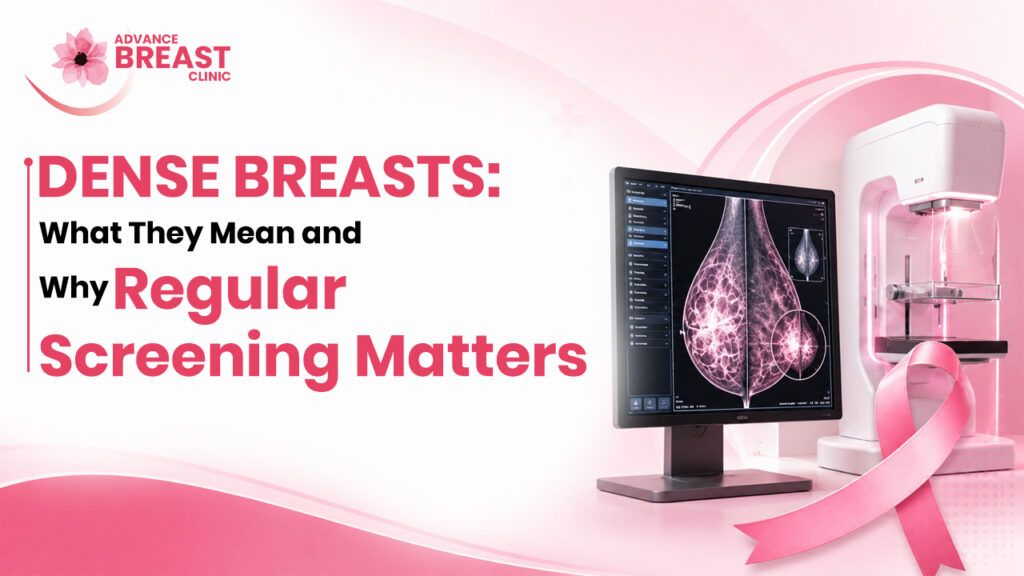
Dense Breasts: What They Mean and Why Regular Screening Matters
A mammogram report that says dense breasts can feel worrying, but dense breast tissue is common and is not a diagnosis of breast cancer. It means there is more fibrous and glandular tissue, and less fatty tissue, visible on a mammogram.
The important next step is not panic. It is understanding how breast density affects screening and discussing a plan that fits your age, symptoms, family history, and overall breast cancer risk.
For women in Nepal, especially those considering mammography or speaking with a breast cancer specialist in Kathmandu, knowing their breast density can support a more informed screening conversation. Dense tissue can make some cancers harder to see on mammograms, yet mammography remains an important part of regular breast screening.
Quick Answer: What Do Dense Breasts Mean?
Dense breasts have a higher proportion of fibroglandular tissue, the milk glands, ducts, and connective tissue compared with fat. Density is a mammographic description, not something a person can reliably determine by breast size, touch, firmness, pain, or self-exam.
Dense tissue and many breast cancers both appear white on a mammogram. This “white-on-white” overlap can reduce how clearly small abnormalities are seen.
Dense breast tissue is also associated with a higher risk of breast cancer than less-dense tissue. However, it does not mean that cancer is present or inevitable.
Dense Breasts Are Not the Same as a Breast Lump
It helps to separate these two concerns:
| Dense breast tissue | Breast lump or new symptom |
|---|---|
| A pattern seen by a radiologist on a mammogram | A change that may be felt, seen, or found on imaging |
| Usually affects both breasts to some degree | May occur in one area or one breast |
| Is common and not a disease by itself | Needs clinical assessment, even if it is likely benign |
| Influences screening choices and image interpretation | May need diagnostic mammography, ultrasound, or biopsy |
A normal mammogram should never be used to ignore a new lump, nipple discharge, skin dimpling, nipple pulling inward, or persistent one-sided breast change. These symptoms need medical assessment rather than waiting for the next routine screening date.
How Do Doctors Know Whether Breasts Are Dense?
Breast density can be assessed only on a mammogram. A radiologist classifies the mammogram using the BI-RADS breast density categories.
Categories C and D are usually described as dense breasts.
| BI-RADS category | Mammogram description | Dense? |
| A | Almost entirely fatty tissue | No |
| B | Scattered areas of fibroglandular tissue | No |
| C | Heterogeneously dense tissue; small masses may be harder to see in dense areas | Yes |
| D | Extremely dense tissue; masses may be more difficult to see | Yes |
In US screening data, roughly half of women having mammograms fall into the dense categories. This is useful context, but it should not be treated as a Nepal-specific prevalence estimate because breast-density data can vary by population and screening programme.
Why Does Breast Density Matter for Breast Cancer Screening?
Breast density matters for two related reasons.
1. It Can Reduce Mammogram Visibility
On a mammogram, fatty tissue usually looks darker, while dense fibrous and glandular tissue looks white. Many breast cancers also appear white.
When there is more dense tissue, a small cancer can be partly hidden by the surrounding white areas.
This does not make mammography useless. Most breast cancers can still be seen on mammograms, and regular mammography remains an important screening tool. The goal is to interpret the report alongside a person’s total risk profile rather than relying on density alone.
2. It Is Linked With Higher Breast Cancer Risk
Dense breast tissue is associated with a higher risk of breast cancer compared with less-dense breast tissue. Researchers are still studying exactly why this association exists.
It may relate to the larger amount of glandular and connective tissue where abnormal cells can develop.
However, density is only one risk factor. A person with dense breasts may never develop cancer, and someone with fatty breasts can still develop breast cancer.
Family history, inherited gene changes, previous chest radiation, previous high-risk biopsy findings, age, hormone exposure, alcohol use, body weight after menopause, and personal history also matter.
Is Having Dense Breasts Bad?
No. Dense breasts are a normal variation in breast composition, not a fault, infection, or disease.
There is no “better” breast type in a general health sense. From an imaging perspective, fatty breasts can make mammograms easier to interpret. From a risk perspective, dense tissue is associated with a higher relative breast cancer risk.
The practical response is regular, risk-based screening and attention to any new breast change.
At What Age Are Breasts Most Dense?
There is no single age when every person has the densest breasts.
Density is generally more common in younger and premenopausal women and often decreases with age, particularly after menopause. Still, some women continue to have dense tissue later in life, while others have little change over time.
Breast density is often inherited. Age, menopausal hormone therapy, body composition, and reproductive factors can also influence it. A mammogram report—not age alone—shows a person’s current breast-density category.
Can Breast Density Go Away?
Breast density can change over time, but it does not always “go away.”
For many women, breasts become less dense as they age. For others, the density category remains similar for years or changes slightly from one mammogram to another.
A change in density does not usually require treatment. It is mainly relevant because it can affect imaging interpretation and whether additional screening should be discussed.
What Screening Is Right for Women With Dense Breasts?
There is no one-size-fits-all answer.
A good screening plan considers:
- Your BI-RADS density category
- Your age and whether you have symptoms
- A first-degree relative with breast or ovarian cancer
- Known inherited mutations, such as BRCA1 or BRCA2
- Previous breast cancer or high-risk biopsy findings
- Previous chest radiation at a young age
- Your previous mammograms and any abnormal results
For average-risk women with dense breasts, mammography is commonly still the foundation of screening.
Depending on local availability and individual risk, a specialist may discuss 3D mammography, targeted or supplemental ultrasound, or breast MRI. These tests can find some cancers not seen on mammography, but they can also lead to more false-positive findings, follow-up imaging, and biopsies.
Therefore, they should be selected thoughtfully not automatically for every person with dense breasts.
Mammography, Ultrasound, and MRI: How Are They Different?
| Test | What it is useful for | Important limitation |
| Mammography | Routine breast cancer screening; detecting calcifications and changes before symptoms | Dense tissue can mask some findings |
| 3D mammography / DBT | Produces thin image slices to reduce tissue overlap | Availability varies; benefit may be less clear in extremely dense breasts |
| Breast ultrasound | Evaluating a lump, cyst, targeted area, or dense-breast situations | Can identify non-cancer findings that lead to extra tests |
| Breast MRI | Higher-risk screening and complex diagnostic situations | More expensive and may result in false-positive findings |
| Biopsy | Confirms whether a suspicious finding is cancer | Used only when imaging or clinical assessment indicates it |
A breast ultrasound is not a replacement for mammography in every person. Likewise, MRI is not a routine screening test for everyone with dense breasts.
The most appropriate test depends on whether the concern is routine screening, a new symptom, an abnormal mammogram, or increased inherited risk.
When Should You See a Breast Specialist Promptly?
Make an appointment promptly if you notice:
- A new breast or underarm lump
- Bloody or spontaneous nipple discharge
- Skin dimpling, thickening, redness, or an orange-peel-like appearance
- A new nipple inversion or persistent crusting around the nipple
- A clear change in breast size, shape, or symmetry
- Persistent pain localised to one area, especially with another change
- A mammogram report that recommends further assessment
These signs do not automatically mean breast cancer. Many breast changes are benign.
However, a specialist can decide whether a clinical examination, diagnostic mammogram, ultrasound, MRI, or biopsy is appropriate. Advance Breast Clinic’s diagnostic facility outlines evaluation pathways that include breast ultrasound and tissue sampling when clinically needed.
A Practical Approach After a Dense Breasts Report
Take these five steps:
- Keep a copy of the report. Look for the BI-RADS density category and any recommendation for additional imaging.
- Ask about your total risk. Density alone does not decide your screening plan.
- Bring old images and reports. Comparing current and previous mammograms can help identify meaningful change.
- Continue recommended mammograms. Dense tissue does not mean you should skip screening.
- Report new symptoms early. Do not wait for the next annual or biennial screening appointment if you find a new change.
For more on how mammography fits into early detection, read Advance Breast Clinic’s guide to mammography in Nepal.
Questions to Ask After a Dense-Breast Result
Taking a mammogram report to a breast consultation can make the discussion more useful.
Consider asking:
- Which density category A, B, C, or D was reported?
- Was there any finding besides breast density that needs follow-up?
- Do my family history, previous biopsies, or other health factors place me at average, intermediate, or high risk?
- Is mammography alone suitable for me?
- Is there a specific reason to consider ultrasound, 3D mammography, or MRI?
- What are the possible benefits, false positive risks, costs, and next steps for any extra test?
- Which symptoms should make me seek care sooner?
These questions keep the focus on shared decision-making. An extra test is most useful when it addresses a clear clinical question, rather than simply adding more imaging because a report uses the word “dense.”
Can Lifestyle Changes Make Dense Breasts Less Dense?
There is no standard medical treatment used to make dense breasts less dense. Dense breast tissue is not an illness that needs to be “cured.”
Do not stop prescribed hormonal medicines or begin supplements solely to change breast density without speaking with your doctor.
Healthy habits can still support overall breast-cancer risk reduction and general health. These include staying physically active, maintaining a healthy body weight, avoiding tobacco, and limiting or avoiding alcohol.
They do not replace screening, and they cannot guarantee prevention. Advance Breast Clinic also explains how body weight can influence breast cancer risk.
Dense Breasts and Breast Cancer Treatment in Nepal
Breast density is relevant mainly to screening and diagnosis. It is not a stage of breast cancer and does not determine treatment by itself.
If testing finds a suspicious area, diagnosis usually involves clinical evaluation, breast imaging, and a biopsy.
When cancer is confirmed, the treatment plan depends on tumour stage, biology such as ER, PR, and HER2 status, lymph-node involvement, general health, and the patient’s values.
Treatment may include breast-conserving surgery, mastectomy, radiation, systemic medicines, and reconstruction planning as appropriate. Learn more about evidence-based breast cancer treatment in Nepal.
Why Personalised Care Matters
A mammogram report is one part of a wider clinical picture. Two women with the same density category may need different plans because their ages, family histories, symptoms, and previous imaging results are different.
Whether a person begins at a breast clinic, imaging centre, or breast hospital in Kathmandu, the priority should be timely clinical assessment, appropriate imaging, and a clear explanation of the next step.
At a dedicated breast cancer clinic in Nepal, a consultation can help turn a technical report into clear next steps.
Advance Breast Clinic describes services that include breast examination, imaging guidance, biopsy pathways, and breast cancer surgery consultation. The clinic is led by Dr. Banira Karki, whose published profile lists breast-oncosurgery fellowship training and oncoplastic surgery training.
Frequently Asked Questions About Dense Breasts
What does it mean if breasts are dense?
It means your mammogram shows more fibrous and glandular tissue than fatty tissue. Dense breasts are common and are not cancer, but they can make mammograms more difficult to interpret and are linked with a higher breast cancer risk.
At what age are breasts most dense?
There is no fixed age. Breast density is often greater in younger or premenopausal women and may decrease after menopause, but some women remain dense later in life. A mammogram report gives the reliable answer for an individual.
Is it better to have fatty or dense breasts?
Neither is “better” as a measure of personal health. Fatty breast tissue generally makes mammograms easier to read, while dense tissue is associated with a higher relative breast cancer risk. Density is a normal trait, so the focus should be appropriate screening rather than trying to change it.
Can breast density go away?
It may decrease with age, especially after menopause, but it may not. Breast density can also remain stable or vary between mammograms. It is monitored through imaging rather than treated as a disease.
What is the treatment for dense breasts?
There is no treatment because dense breasts are not an illness. The recommended approach is personalised screening, awareness of new breast changes, and a discussion with a qualified breast specialist about whether additional imaging is appropriate.
What are the four stages of dense breast tissue?
They are not stages; they are four BI-RADS density categories: A, almost entirely fatty; B, scattered fibroglandular tissue; C, heterogeneously dense; and D, extremely dense. Categories C and D are considered dense breasts.
Takeaway
Dense breasts are common, manageable, and not a diagnosis of cancer.
Their importance lies in two things: they can make some cancers harder to see on a mammogram, and they are associated with a higher breast cancer risk than less-dense tissue.
Keep regular screening appointments, ask what your density means in the context of your full risk profile, and seek prompt assessment for any new breast change.
To discuss a report or symptom with a breast cancer specialist in Kathmandu Valley, contact Advance Breast Clinic.
Medical review: Dr. Banira Karki, MBBS, MS, DMAS, FMAS
Fellowship in Breast Oncosurgery, Tata Medical Center; Training in Oncoplastic Surgery, Germany.
Medical disclaimer: This article is for general education and does not replace individual medical advice, diagnosis, or treatment. A new breast symptom or an abnormal test result should be assessed by a qualified health professional.