How Effective Is Breast Cancer Treatment in Nepal? An Evidence-Based Overview
Breast cancer remains one of the most commonly diagnosed cancers among women worldwide. In Nepal, growing awareness and improved access to healthcare have led to earlier diagnosis in many cases, but questions still remain around one central concern: How effective is breast cancer treatment in Nepal?
This article provides an evidence-based overview of breast cancer treatment in Nepal, including early detection, diagnostic accuracy, treatment outcomes, and the role of specialized care. The focus is onad clinical effectiveness, not promotion, helping readers understand what modern breast cancer care looks like in the Nepali context.
Understanding Breast Cancer
Breast cancer occurs when abnormal cells grow uncontrollably in breast tissue. These cells can invade surrounding tissue and, if untreated, spread to other parts of the body.
Breast cancer can affect:
- Women of all ages
- Men (rare but possible)
The effectiveness of breast cancer treatment depends largely on early detection, accurate staging, and appropriate treatment selection.
Breast Cancer Burden in Nepal
Data from regional cancer registries and hospital-based studies indicate that breast cancer is among the top cancers affecting women in Nepal. While national screening programs are still evolving, urban centers have seen improved diagnostic capacity over the past decade.
Key challenges historically included:
- Late presentation
- Limited screening awareness
- Unequal access to specialized care
However, treatment outcomes have improved with the growth of specialized breast services and multidisciplinary oncology care.
Recognizing Breast Cancer Symptoms Early
Early recognition of breast cancer symptoms plays a critical role in treatment success.
Common symptoms include:
- A new lump in the breast or underarm
- Change in breast size or shape
- Nipple inversion or discharge
- Skin dimpling or redness
- Persistent breast pain unrelated to menstrual cycles
Not all breast changes are cancerous, but persistent symptoms require medical evaluation.
Breast Cancer Screening in Nepal
Breast cancer screening aims to detect disease before symptoms appear.
Screening methods commonly used include:
- Clinical breast examination
- Mammography (age and risk-dependent)
- Ultrasound in younger women or dense breasts
While nationwide screening coverage is limited, hospital-based screening programs and awareness initiatives have helped increase early detection rates, particularly in urban areas.
Breast Cancer Stages and Why They Matter
Breast cancer is classified into stages based on tumor size, lymph node involvement, and spread.
Overview of Breast Cancer Stages
| Stage | Description | Treatment Implications |
| Stage 0 | Non-invasive | Local treatment |
| Stage I | Small, localized tumor | High cure rates |
| Stage II | Larger tumor or limited nodes | Combined therapies |
| Stage III | Advanced local disease | Multimodal treatment |
| Stage IV | Metastatic cancer | Disease control focus |
Earlier breast cancer stages are associated with significantly better outcomes, highlighting the importance of timely diagnosis.
Diagnostic Accuracy and Modern Evaluation
Effective treatment begins with accurate diagnosis.
Standard diagnostic steps include:
- Clinical examination
- Imaging (mammography, ultrasound, MRI where indicated)
- Tissue biopsy
- Receptor testing (ER, PR, HER2)
These investigations guide personalized treatment planning and improve clinical outcomes.
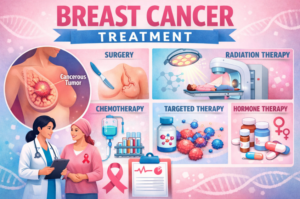
Breast Cancer Treatment Modalities in Nepal
Modern breast cancer treatment in Nepal follows internationally accepted oncology principles and guidelines, adapted to local context.
Breast Cancer Surgery
Breast cancer surgery remains a cornerstone of treatment for early and locally advanced disease.
Surgical approaches include:
- Breast-conserving surgery (lumpectomy)
- Mastectomy
- Sentinel lymph node biopsy or axillary dissection
Advances in surgical technique have improved:
- Disease control
- Cosmetic outcomes
- Recovery time
Surgery is most effective when combined with appropriate adjuvant therapies.
Chemotherapy
Chemotherapy is used to:
- Shrink tumors before surgery
- Reduce recurrence risk after surgery
- Control advanced disease
Treatment protocols are selected based on cancer stage, biology, and patient health status.
Radiation Therapy
Radiation therapy targets residual cancer cells in the breast or chest wall and is commonly used after breast-conserving surgery or mastectomy in selected cases.
Hormonal and Targeted Therapy
Hormone-positive breast cancers benefit from endocrine therapy, while HER2-positive cancers respond to targeted treatments.
These therapies have significantly improved survival rates globally and are increasingly accessible in Nepal.
Effectiveness of Breast Cancer Treatment in Nepal
Clinical outcomes in Nepal vary by:
- Stage at diagnosis
- Tumor biology
- Treatment adherence
- Access to multidisciplinary care
Hospital-based studies and clinical audits suggest that early-stage breast cancer treated in Nepal achieves outcomes comparable to regional benchmarks, particularly when managed in specialized centers.
Importance of Specialized Breast Clinics
Specialized care improves coordination and outcomes.
Facilities such as Advance Breast Clinic focus on:
- Early diagnosis
- Multidisciplinary planning
- Patient education and follow-up
Dedicated breast clinics help streamline care and reduce treatment delays.
Clinical Perspective from Breast Care Practice

According to clinical insights commonly associated with Dr. Banira Karki, effective breast cancer management depends on early detection, accurate staging, and individualized treatment.
Clinical experience highlights that when patients present early and receive coordinated care, treatment outcomes are significantly improved, even within resource-limited settings.
Follow-Up and Survivorship Care
Treatment effectiveness extends beyond initial therapy.
Follow-up care helps:
- Detect recurrence early
- Manage long-term side effects
- Support physical and emotional recovery
Survivorship programs are an increasingly important component of breast cancer care in Nepal.
Barriers That Affect Treatment Outcomes
Despite progress, challenges remain:
- Late presentation in rural areas
- Financial constraints
- Limited awareness about screening
- Treatment discontinuation
Addressing these barriers is essential to further improve national outcomes.
Evidence-Based Improvements Over Time
Over the past decade, improvements in Nepal have included:
- Better imaging availability
- Increased pathology accuracy
- Expanded oncology training
- Improved surgical techniques
These changes collectively contribute to more effective breast cancer treatment nationwide.
Medical Review & Professional Disclaimer
This article is intended for educational and informational purposes only. Diagnosis and treatment decisions should always be made in consultation with qualified medical professionals and oncology specialists.
Frequently Asked Questions (FAQ)
Is breast cancer treatment effective in Nepal?
Yes. When diagnosed early and treated appropriately, outcomes are increasingly favorable.
What stage of breast cancer has the best prognosis?
Early stages (Stage I and II) generally have high treatment success rates.
Is breast cancer screening available in Nepal?
Yes, mainly through hospitals and specialized clinics.
Does surgery cure breast cancer?
Surgery is a key component but is often combined with other treatments for best results.
Can breast cancer recur after treatment?
Yes, which is why follow-up care is essential.
Final Overview
So, how effective is breast cancer treatment in Nepal?
Evidence suggests that effectiveness is strongly linked to early detection, proper staging, and access to coordinated care. While challenges remain, modern breast cancer management in Nepal continues to improve, offering hope and better outcomes for many patients.