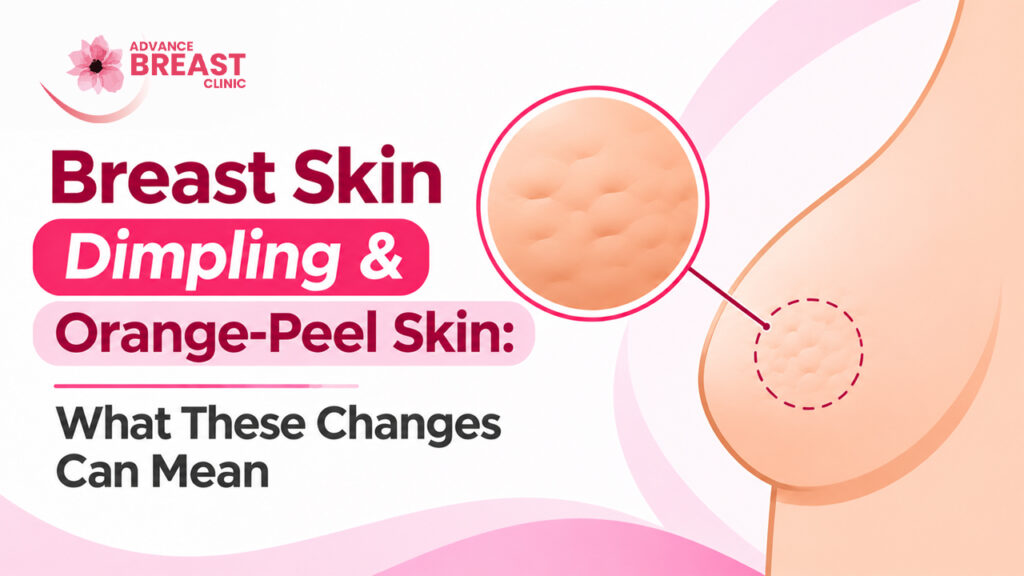
Breast Skin Dimpling & Orange-Peel Skin: What These Changes Can Mean
Noticing a dent, puckering, or unusual texture on your breast can be unsettling. Perhaps one area looks pulled inward, or the skin has developed tiny pits resembling the peel of an orange. These changes may appear gradually or develop over a short period.
Breast skin dimpling and orange-peel skin do not automatically mean breast cancer. They can occur with noncancerous conditions, including inflammation, infection, or changes following breast surgery. However, they are also recognized warning signs of breast cancer, including inflammatory breast cancer.
The important thing is not to diagnose the cause by appearance alone.
According to the National Cancer Institute’s guidance on breast cancer symptoms, unusual breast skin changes should be assessed by a healthcare professional, even when there is no noticeable lump.
This guide explains what breast dimpling looks like, why it happens, which symptoms need prompt attention, and how medical professionals investigate these changes.
What Is Breast Skin Dimpling?
Breast skin dimpling is a visible change in the surface of the breast that causes one or more areas to appear indented, puckered, or pulled inward.
A person may notice a small depression in an otherwise smooth breast surface. Sometimes, the change becomes more obvious when raising an arm, changing position, or looking at the breast from a different angle.
Dimpling may affect a small area or be part of more extensive changes involving the breast skin.
The appearance can develop when underlying breast tissue affects the skin or when inflammation and fluid accumulation alter the skin’s normal structure.
The skin and the deeper breast tissue are connected by supportive structures. Changes involving those structures may sometimes create visible pulling or distortion.
Breast dimpling should not be confused with every natural crease, skin fold, or variation in breast shape. Breasts differ in size, contour, and texture, and some asymmetry is normal.
The important question is whether the appearance represents a new or unexplained change from what is usual for you.
The Cleveland Clinic’s medical explanation of breast dimpling describes both benign and cancer-related conditions that may produce this appearance.
What Is Orange-Peel Skin on the Breast?
Orange-peel skin is a change in breast skin texture that resembles the surface of an orange.
The medical term is peau d’orange.
Instead of looking smooth, the affected skin may become thicker, swollen, or uneven, with small visible pits around the pores.
The appearance can develop when fluid accumulates within the skin, making the pores and surrounding tissue appear more prominent.
One possible reason is interference with normal lymphatic drainage. Lymphatic vessels help move fluid through tissues. When fluid drainage is disrupted, swelling can change the skin’s appearance.
Orange-peel skin is an important symptom because it can occur with breast inflammation, infection, and inflammatory breast cancer.
The National Cancer Institute identifies peau d’orange as a characteristic possible skin change in inflammatory breast cancer.
However, the appearance alone cannot establish the diagnosis.
Breast Dimpling vs. Orange-Peel Skin
Although the terms are sometimes used together, they do not always describe exactly the same appearance.
| Feature | Breast dimpling | Orange-peel skin |
|---|---|---|
| Typical appearance | A dent, depression, or puckered area | Multiple small pits with an uneven texture |
| Distribution | May be localized | May involve a broader area |
| Skin thickness | May be unchanged | May appear thickened or swollen |
| Possible underlying cause | Tissue pulling, scarring, inflammation, or a breast lesion | Skin swelling, inflammation, or impaired lymphatic drainage |
| Clinical importance | New changes need assessment | New changes need prompt assessment |
These are descriptive differences, not a method of distinguishing cancer from noncancerous conditions.
A single dimple can be clinically important, and widespread pitting does not by itself prove that cancer is present.
What Causes Breast Skin Dimpling and Orange-Peel Skin?
Several conditions can change breast skin appearance. Some are benign, while others require more extensive medical evaluation.
1. Inflammation and Breast Infection
Mastitis is inflammation of breast tissue, often associated with infection.
It is particularly common during breastfeeding, although it can also occur in people who are not breastfeeding.
Mastitis may cause swelling, warmth, tenderness, pain, and changes in breast skin colour or texture.
An affected breast may appear red on lighter skin or darker than usual on brown or darker skin tones.
Inflammation and swelling can sometimes produce an uneven surface.
Because some breast cancer symptoms can resemble infection, it is important not to assume that redness or swelling is harmless.
If symptoms do not improve as expected with treatment, medical reassessment is necessary.
The NHS guidance on mastitis explains when symptoms need medical attention, including when they persist despite treatment.
2. Scar Tissue and Previous Breast Surgery
Previous breast surgery or an injury can change the structure of the tissue underneath the skin.
As healing occurs, scar tissue may cause localized pulling, firmness, or a visible indentation.
A familiar, stable scar-related change may have a different explanation from a newly developing dimple.
Nevertheless, a new skin change should not automatically be attributed to an old operation.
A clinician may need to compare the appearance with previous examinations, imaging, and surgical history.
3. Fat Necrosis
Fat necrosis is a noncancerous condition that occurs when fatty tissue within the breast becomes damaged.
It may develop following injury, surgery, or other changes affecting breast tissue.
Sometimes fat necrosis causes a lump or an area of firmness. It may also affect the contour of the breast or produce skin changes.
Because its appearance can occasionally resemble other breast abnormalities, imaging and, in selected situations, biopsy may be needed to establish the cause.
The Cleveland Clinic’s breast-dimpling resource discusses fat necrosis among the possible benign explanations.
4. Fibrocystic Breast Changes
Fibrocystic changes are noncancerous variations in breast tissue that may cause lumpiness, tenderness, or changes in texture.
Some individuals notice that their breasts feel different at certain points in the menstrual cycle.
Occasionally, changes in underlying tissue may contribute to an uneven surface.
However, a new persistent indentation should not simply be assumed to result from menstrual or hormonal changes.
A clinical examination can help determine whether further investigation is necessary.
5. Breast Cancer
Certain breast cancers can affect the appearance of the overlying skin.
For example, a cancerous lesion may alter surrounding tissue and produce pulling or puckering.
Some cancers can also affect the lymphatic vessels in the skin, contributing to swelling and orange-peel texture.
Importantly, breast cancer does not always cause a painful or easily detectable lump.
The CDC’s breast cancer symptom guidance includes breast skin dimpling, swelling, and changes in breast appearance among symptoms requiring medical attention.
This does not mean that everyone with dimpling has cancer. It means the underlying cause should be properly investigated.
Which Breast Skin Changes Should You Be Concerned About?
A new skin change is more important than a long-standing feature that has remained unchanged.
Arrange medical assessment if you notice:
- A new indentation or area of puckering on one breast.
- Skin that has developed an orange-peel texture.
- Unexplained swelling or thickening.
- Persistent redness or darker discoloration.
- A newly inverted or pulled-in nipple.
- A lump or area of firmness in the breast or armpit.
- Unexpected nipple discharge, especially if bloody.
- A noticeable change in breast shape or size.
These symptoms can occur with conditions other than cancer, but they should not be dismissed.
Do not wait for pain to develop. A concerning breast condition may be painless.
Seek urgent medical attention if the breast becomes rapidly swollen, increasingly red or discoloured, hot, or painful, especially if you also have fever or feel significantly unwell.
Prompt care is important because serious infection and certain breast cancers may require timely investigation.
Can Orange-Peel Skin Be a Sign of Inflammatory Breast Cancer?
Yes. Orange-peel skin is one possible sign of inflammatory breast cancer (IBC), a rare but fast-growing form of breast cancer.
Inflammatory breast cancer behaves differently from many other breast cancers.
Rather than initially appearing as a distinct lump, it may cause widespread changes in the breast skin.
In inflammatory breast cancer, cancer cells can obstruct lymphatic vessels in the skin. This interferes with normal fluid drainage and may cause swelling, discoloration, thickening, and a pitted texture.
Possible symptoms include:
- Rapid swelling or enlargement of one breast.
- Pink, red, purple, or darker discoloration.
- Skin thickening and orange-peel texture.
- Breast warmth, heaviness, or tenderness.
- New nipple inversion.
- Swollen lymph nodes in the armpit or near the collarbone.
A person may experience several of these symptoms without feeling a distinct breast lump.
The National Cancer Institute’s inflammatory breast cancer guide describes this presentation and the investigations used to confirm or exclude the disease.
Why Can Inflammatory Breast Cancer Be Confused with Mastitis?
Both conditions may produce swelling, tenderness, warmth, and changes in skin colour.
This overlap means an initial examination may raise more than one possible diagnosis.
An infection may improve with appropriate treatment. Inflammatory breast cancer generally requires a different diagnostic and treatment pathway.
If presumed mastitis does not improve as expected, or if symptoms are rapidly progressing, reassessment is essential.
You should not repeatedly self-treat a persistent breast change with creams, antibiotics, or home remedies instead of obtaining professional evaluation.
What Should You Do If You Notice Breast Dimpling?
The most helpful next step is to arrange an assessment with a qualified healthcare professional.
There are several ways to prepare for that visit.
Notice What Has Changed
Think about when you first noticed the dimpling and whether it has become more visible.
Is it present all the time? Does it seem more apparent when your arm is raised? Has the surrounding breast become swollen or changed shape?
These details may help your doctor understand the symptom.
Look for Associated Changes
Observe whether there is additional swelling, a lump, nipple change, discharge, pain, or skin discoloration.
You do not need to repeatedly press or squeeze the affected area.
A gentle visual assessment is enough to identify what you want to discuss.
Arrange a Clinical Examination
A clinician can assess whether the change appears related to inflammation, a previous scar, an underlying breast abnormality, or another condition.
If the skin has changed suddenly or the breast is becoming increasingly swollen or discoloured, seek assessment promptly.
Avoid Self-Diagnosis from Photographs
Online images can help explain medical terminology, but photographs cannot reliably distinguish benign dimpling from a cancer-related change.
Skin tone, lighting, angle, and breast anatomy can also affect how an indentation appears.
Do not rely on an image comparison to decide whether a medical appointment is necessary.
How Do Doctors Investigate Breast Dimpling?
Medical evaluation usually begins with a discussion of symptoms and a clinical breast examination.
Depending on the findings, a healthcare professional may recommend imaging or tissue sampling.
1. Medical History
Your clinician may ask:
- When did the skin change begin?
- Has it developed suddenly or gradually?
- Is there pain, warmth, swelling, or discharge?
- Have you had previous breast surgery or injury?
- Are you pregnant or breastfeeding?
- Have you had previous breast investigations?
- Is there a personal or family history of breast cancer?
These questions help place the visible change in the context of your overall breast health.
2. Clinical Breast Examination
The clinician may examine both breasts, nipples, and the areas under the arms.
They may look at the skin while you are sitting, standing, or changing arm position.
The examination helps identify visible changes, areas of thickening, tenderness, or an underlying lump.
However, a physical examination alone cannot reliably establish every cause of breast dimpling.
You can learn more about this process through Advance Breast Clinic’s breast consultation and clinical examination information.
3. Breast Ultrasound
Ultrasound uses sound waves to create images of the tissues inside the breast.
It may help identify an abnormality beneath the area of dimpling or investigate associated swelling or a palpable lump.
Ultrasound is commonly useful in evaluating particular breast symptoms, including in younger patients and during pregnancy when clinically appropriate.
The choice of investigation depends on the patient’s history, examination findings, age, and other circumstances.
For more information, see the clinic’s breast ultrasound resource.
4. Diagnostic Mammography
A diagnostic mammogram is an X-ray examination used to investigate a specific breast concern.
Unlike routine screening, diagnostic imaging is requested because there is a symptom or a finding that requires assessment.
It may identify tissue changes that are not easily detected during a physical examination.
Some patients may require both mammography and ultrasound because the tests provide complementary information.
However, neither test excludes every breast cancer in every situation.
A new clinical finding may need further evaluation even when a recent screening mammogram was reported as normal.
The National Cancer Institute emphasizes this point in its guidance on breast changes.
5. Breast MRI
Breast MRI is not necessary for everyone with skin dimpling.
However, a specialist may consider MRI in selected circumstances when clinical findings and other investigations require additional clarification.
MRI can provide detailed information about breast tissue, but its use should be guided by the clinical question.
More imaging is not automatically better; the most appropriate investigation is the one suited to the individual presentation.
6. Breast or Skin Biopsy
A biopsy may be recommended when a finding is suspicious or cannot be adequately explained through clinical examination and imaging.
A biopsy removes cells or a small amount of tissue for examination by a pathologist.
Depending on the situation, a clinician may recommend a core needle biopsy or another appropriate sampling procedure. In selected cases, a skin biopsy may also be considered.
Being advised to have a biopsy does not mean breast cancer has already been diagnosed.
It means further evidence is needed to determine the cause.
For a practical explanation, read Advance Breast Clinic’s guide to breast biopsy, FNAC, core biopsy, and results.
What If the Mammogram or Ultrasound Is Normal?
A reassuring imaging result is valuable, but it should be interpreted together with the clinical examination and the person’s symptoms.
If a new indentation remains unexplained, the clinician may need to determine whether imaging adequately evaluated the precise area of concern.
Sometimes a benign explanation becomes clear from the examination and imaging.
At other times, further assessment or follow-up is needed.
If the physical finding remains concerning, it should not be ignored solely because an earlier test was normal.
Patients receiving an imaging report may also encounter a BI-RADS category, which is a standardized way to communicate breast-imaging findings.
Advance Breast Clinic explains these categories in its BI-RADS mammogram and ultrasound guide.
If your symptoms change or progress after an initial evaluation, contact your healthcare professional for reassessment.
Breast Skin Dimpling in Different Situations
During Breastfeeding
Breastfeeding can be associated with mastitis and other inflammatory breast conditions.
These may cause tenderness, swelling, redness, and changes in skin texture.
Although infection is a common consideration during breastfeeding, new dimpling or orange-peel skin should still be assessed.
If symptoms persist or do not improve as expected, further evaluation may be necessary.
After Breast Surgery
Surgical healing can change breast contour and cause scar-related pulling of the skin.
If a dimple is located close to a known scar and has been stable since surgery, that history may help explain its appearance.
But a new, enlarging, or otherwise changing indentation deserves assessment, even in a previously operated breast.
Without a Breast Lump
Not feeling a lump does not automatically rule out breast cancer.
Some breast conditions affect the skin or deeper tissue without producing a lump that can be easily detected by touch.
Inflammatory breast cancer is one important example.
Therefore, visible skin changes should be taken seriously even if the rest of the breast feels normal.
Frequently Asked Questions About Breast Dimpling
Does breast dimpling always mean cancer?
No. Dimpling may arise from inflammation, scarring, fat necrosis, or other benign breast conditions. Nevertheless, new or unexplained dimpling should be assessed because breast cancer is also a possible cause.
Can breast cancer cause dimpling without pain?
Yes. A breast skin change may occur without pain. The absence of pain is not enough to determine whether a finding is harmless.
Can inflammatory breast cancer occur without a lump?
Yes. Inflammatory breast cancer often presents with skin swelling, discoloration, thickening, or orange-peel texture rather than a clearly palpable mass.
Can breast dimpling disappear on its own?
Some changes related to temporary inflammation may improve when the underlying cause resolves. However, improvement does not by itself establish a diagnosis, and persistent or recurrent changes require medical advice.
Should I wait for my next routine mammogram?
No. A new breast skin change is a symptom that deserves clinical assessment rather than waiting for the next routine screening appointment. Your doctor can determine whether diagnostic imaging is needed.
Getting Breast Skin Changes Checked in Kathmandu Valley
If you notice new breast skin dimpling or an orange-peel appearance, consider visiting breast hospital, or consulting a qualified doctor or breast-health specialist.
Advance Breast Clinic is located in Jawalakhel, Lalitpur, and publishes information about breast examinations, ultrasound, and breast diagnostic services.
A clinical consultation can help establish whether your symptoms require imaging, biopsy, treatment, or another appropriate next step.
For appointment enquiries and current service information, visit the clinic’s official contact page.
If symptoms are rapidly progressing or you are acutely unwell, seek urgent medical care rather than waiting for a routine clinic appointment.
Final Thoughts
Breast skin dimpling and orange-peel skin are visible changes that deserve attention, but they are not diagnoses on their own.
They may occur because of noncancerous conditions such as infection, inflammation, or scarring. In some cases, they are warning signs of breast cancer, including inflammatory breast cancer.
The safest approach is to notice changes early, avoid assumptions based only on appearance, and obtain professional medical assessment.
A new or unexplained breast skin change should be checked, even when there is no pain or lump.
For information about arranging a breast-health assessment in Lalitpur, contact Advance Breast Clinic.
This article provides general health education and does not replace an individualized medical evaluation or diagnosis.