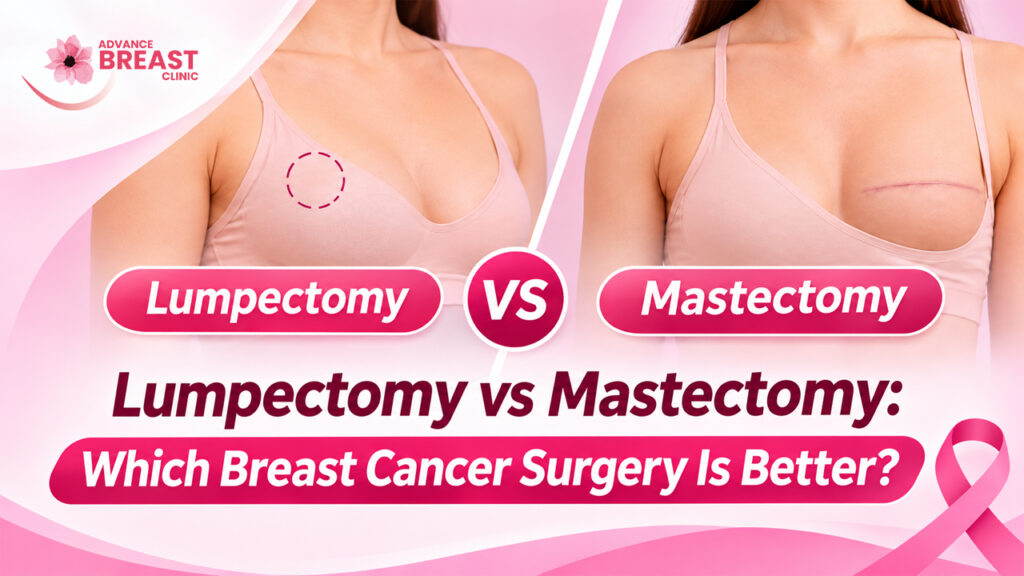
Lumpectomy vs Mastectomy: Which Breast Cancer Surgery Is Better?
Being diagnosed with breast cancer can bring many difficult decisions. One of the most important is whether to have a lumpectomy or a mastectomy. Both operations are established treatments for breast cancer, but they differ in how much breast tissue is removed, the need for additional treatment, recovery and the effect on breast appearance.
So, which is better: lumpectomy or mastectomy?
For many people with early-stage breast cancer who are eligible for either procedure, lumpectomy followed by appropriate radiotherapy and mastectomy offer similar long-term survival outcomes. Removing the entire breast does not automatically mean a better chance of survival.
The best operation depends on tumour size and location, the extent of cancer within the breast, previous treatment, genetic risk, overall health and personal preferences.
According to the US National Cancer Institute’s guide to choosing between lumpectomy and mastectomy, patients who are suitable for both procedures can consider the advantages and limitations of each approach with their treating team.
This guide explains the medical differences, recovery expectations, risks and important questions to discuss with a breast surgeon, including practical considerations for patients receiving treatment in Nepal.
What Is a Lumpectomy?
A lumpectomy, also called breast-conserving surgery, removes the cancerous tumour and a surrounding margin of breast tissue while preserving most of the breast.
It may also be described as a wide local excision, partial mastectomy or segmental mastectomy, depending on the procedure.
The goal is to remove the cancer completely while retaining as much healthy breast tissue as safely possible.
After surgery, a pathologist examines the removed tissue and its edges, called surgical margins, to check whether further surgery may be needed.
Lumpectomy is commonly followed by radiotherapy to lower the risk of cancer returning in the treated breast.
Advantages of lumpectomy
Lumpectomy may offer several benefits for eligible patients:
- Most of the natural breast is preserved.
- The operation is generally less extensive than a mastectomy.
- Initial surgical recovery is often shorter.
- Breast reconstruction may not be necessary, although reshaping techniques may be helpful.
- Long-term survival is comparable to mastectomy when appropriate patients receive recommended treatment.
Limitations of lumpectomy
Lumpectomy is not suitable for every cancer. Radiation is usually recommended afterward, and some patients need another operation if cancer is found at the margins.
The treated breast may also become smaller, firmer or differently shaped, particularly when a relatively large amount of tissue is removed.
More information is available in the National Cancer Institute’s explanation of lumpectomy.
What Is a Mastectomy?
A mastectomy is an operation that removes the whole breast containing the cancer.
It may be recommended when the cancer affects a large area, when several separate areas contain cancer, or when breast-conserving surgery cannot adequately remove the disease.
Different mastectomy approaches include:
Simple or total mastectomy: Removes the breast tissue, typically including the nipple and areola.
Skin-sparing mastectomy: Preserves much of the breast skin to support reconstruction when medically appropriate.
Nipple-sparing mastectomy: Preserves the nipple and surrounding skin in selected patients whose cancer location and other characteristics make this safe.
Modified radical mastectomy: Removes the breast along with a more extensive operation on lymph nodes under the arm when indicated.
Mastectomy may be performed with immediate breast reconstruction, delayed reconstruction or without reconstruction.
Importantly, mastectomy does not always eliminate the need for radiotherapy, chemotherapy or other cancer treatments.
The National Cancer Institute’s mastectomy guidance explains when this operation may be recommended.
Lumpectomy vs Mastectomy: Key Differences
| Factor | Lumpectomy | Mastectomy |
|---|---|---|
| Breast tissue removed | Tumour plus surrounding tissue | Whole breast |
| Breast preservation | Most breast tissue remains | Natural breast is removed |
| Survival in eligible early-stage patients | Comparable with appropriate radiotherapy | Comparable |
| Radiotherapy | Usually recommended | Sometimes required |
| Recovery from initial surgery | Generally shorter | Generally longer, especially with reconstruction |
| Appearance | Breast usually retained but may change shape | Flat chest, prosthesis or reconstruction are options |
| Additional surgery | May be needed for positive margins | May be needed for reconstruction or complications |
| Local recurrence | Possible in remaining breast | Possible in chest wall or skin |
| Best suited to | Selected cancers that can be fully removed while preserving the breast | Selected extensive cancers or situations where conservation is unsuitable |
Both treatments aim to control cancer effectively. Neither should be judged solely by how much tissue is removed.
Which Surgery Has a Better Breast Cancer Survival Rate?
One of the biggest concerns patients have is whether choosing the smaller operation could reduce their chances of survival.
For appropriately selected patients with early-stage breast cancer, extensive clinical evidence demonstrates that breast-conserving surgery followed by recommended radiotherapy and mastectomy provide comparable long-term survival.
This is a crucial distinction: a more extensive operation is not necessarily a more effective cancer treatment.
The National Cancer Institute’s comparison explains that women receiving breast-conserving surgery have survival outcomes comparable to those receiving mastectomy.
However, these findings should not be interpreted as meaning that every patient can safely choose either operation.
Cancer size, distribution, biology, lymph-node involvement, other health conditions and the ability to complete recommended treatment all influence the decision.
Does mastectomy prevent breast cancer from returning?
No surgery completely eliminates the possibility of recurrence.
After lumpectomy, cancer may return in the remaining breast tissue. Radiotherapy substantially reduces this risk.
After mastectomy, cancer can still return in the skin, chest wall or nearby tissues because microscopic breast tissue or cancer cells may remain.
Some evidence shows a somewhat lower risk of local recurrence after mastectomy, but that difference does not automatically translate into better overall survival for patients who are eligible for breast-conserving treatment.
Local recurrence and overall survival are different outcomes.
Local recurrence describes cancer returning in or near the original breast area. Overall survival concerns how long people live after treatment.
A useful discussion with your surgeon should address both your estimated local recurrence risk and your broader prognosis rather than treating them as the same question.
Who Is a Good Candidate for Lumpectomy?
Lumpectomy may be appropriate when the breast cancer can be removed with satisfactory margins while preserving an acceptable breast shape.
Factors that often support breast-conserving surgery include:
- A tumour that is relatively small compared with the breast.
- Cancer located in a limited area of the breast.
- A reasonable likelihood of achieving clear surgical margins.
- The ability to receive recommended radiotherapy.
- The patient’s preference to preserve the natural breast.
A small tumour does not automatically guarantee eligibility. Imaging may reveal additional areas of disease, and the relationship between tumour size and breast volume is important.
Conversely, having a larger tumour does not always mean mastectomy is unavoidable.
Some patients receive systemic treatment, such as chemotherapy, before surgery to shrink the tumour and potentially make breast-conserving surgery possible.
This approach is called neoadjuvant therapy. The National Cancer Institute’s chemotherapy guidance describes its use in selected cases.
Can oncoplastic surgery help preserve the breast?
Sometimes, yes.
Oncoplastic breast surgery combines cancer removal with techniques that reshape the remaining breast.
This may be helpful when removing the tumour would otherwise leave a noticeable indentation or difference in breast shape.
The primary priority remains safe cancer removal. Cosmetic planning must never compromise appropriate margins or oncological treatment.
Patients who want to understand these options can explore breast reconstruction and reshaping procedures as part of their surgical discussion.
When Might Mastectomy Be the Better Option?
Mastectomy may be the more appropriate treatment when breast conservation is unlikely to remove the cancer adequately or when radiotherapy is unsuitable.
Common considerations include:
1. Cancer extends through a large area of the breast
When the tumour or an area of ductal carcinoma in situ (DCIS) is large compared with breast size, lumpectomy may not preserve enough healthy tissue.
2. Cancer is present in multiple separate areas
Multiple cancers in different parts of the breast can make breast conservation more complex.
However, selected patients with more than one tumour may still be considered for breast-conserving treatment, depending on the extent and location of disease.
3. Clear surgical margins cannot be achieved
If cancer cells remain at the margin after lumpectomy, further surgery may be necessary.
When adequate removal cannot be achieved with another breast-conserving operation, mastectomy may be recommended.
4. Radiotherapy is unsuitable
Previous chest radiotherapy, certain medical conditions, pregnancy-related treatment considerations or difficulties accessing radiotherapy may influence the surgical recommendation.
Pregnancy does not automatically mean mastectomy is required. Treatment must be planned according to the stage of pregnancy and the cancer.
5. Certain inherited cancer risks are present
Patients with particular inherited pathogenic variants, including BRCA1 or BRCA2, may need additional counselling about future breast cancer risk and risk-reducing surgery.
This does not mean everyone with a family history requires a double mastectomy.
6. Inflammatory breast cancer is diagnosed
Inflammatory breast cancer generally requires a different treatment sequence, often involving systemic therapy before surgery. Mastectomy is commonly part of the surgical approach when appropriate.
The final decision should be based on specialist evaluation, not a single factor considered in isolation.
Will I Need Radiation After Lumpectomy or Mastectomy?
Radiotherapy is one of the most important differences to understand before choosing an operation.
Radiation after lumpectomy
Most patients undergoing breast-conserving surgery are advised to receive radiotherapy after healing.
Radiation targets microscopic cancer cells that could remain in the breast and reduces the chance of local recurrence.
Modern radiotherapy plans vary. Some patients receive a shorter course, while others require more extensive treatment. Selected patients may be eligible for partial-breast irradiation instead of whole-breast irradiation.
The American Society for Radiation Oncology’s partial-breast irradiation guideline explains evidence-based options for selected early-stage cancers and DCIS.
Some carefully selected older patients with favourable, hormone receptor-positive cancers may be offered lumpectomy without radiotherapy after discussing the increased local recurrence risk and the importance of other recommended treatment.
Radiation omission is an individualized clinical decision, not a general advantage of lumpectomy.
Radiation after mastectomy
Mastectomy does not guarantee that radiation can be avoided.
Postmastectomy radiotherapy may still be recommended depending on the cancer’s extent, lymph-node involvement and other recurrence-risk factors.
Before choosing mastectomy mainly to avoid radiation, ask your oncology team whether radiation is likely to be recommended even after complete breast removal.
What about chemotherapy and hormone therapy?
The choice of breast operation does not independently determine whether chemotherapy, endocrine therapy, HER2-targeted treatment or other systemic treatment is needed.
These decisions depend on factors such as cancer stage, tumour grade, lymph-node findings and hormone receptor and HER2 status.
A patient may need systemic treatment after either operation.
For a broader explanation of coordinated treatment, see breast cancer care in Nepal.
Recovery After Lumpectomy vs Mastectomy
Recovery varies with the extent of surgery, lymph-node procedures, reconstruction, other medical conditions and individual healing.
Recovery after lumpectomy
Lumpectomy is generally the smaller operation.
Many patients can return to light daily activities relatively soon, although discomfort, bruising and swelling may continue during healing.
Some people return to usual activities within approximately two weeks, while others need longer, especially after additional surgery.
Radiotherapy, when recommended, begins after suitable healing and adds to the overall treatment schedule.
Recovery after mastectomy
Mastectomy involves more extensive tissue removal and usually requires a longer recovery.
Some patients need surgical drains to remove fluid during early healing.
Tightness, discomfort, reduced shoulder movement and numbness can occur.
Reconstruction may increase the length and complexity of recovery, particularly when tissue is transferred from another part of the body.
Patients should follow their own surgical team’s instructions about wound care, arm exercises, lifting, driving and returning to work.
For more detailed practical guidance, read breast care after surgery.
What complications can happen?
Both operations carry potential risks, including bleeding, wound infection, fluid accumulation, delayed healing, persistent pain and changes in breast sensation.
If lymph nodes are removed or treated, arm swelling known as lymphoedema may also occur.
Mastectomy with reconstruction can involve additional risks, including implant-related complications or problems with transferred tissue.
Contact your treating team promptly if you develop fever, worsening redness, wound discharge or rapidly increasing swelling.
Seek urgent medical attention for severe bleeding, chest pain, significant breathing difficulty or other sudden serious symptoms.
Breast Appearance, Sensation and Reconstruction
Appearance and body image are legitimate considerations when choosing breast cancer surgery.
Lumpectomy preserves most of the breast, but its appearance may change because tissue has been removed. Radiotherapy may also affect skin texture, firmness and shape.
Mastectomy removes the natural breast. Some patients choose reconstruction, while others prefer a flat chest or an external breast prosthesis.
Reconstruction options after mastectomy
Reconstruction may use implants, the patient’s own tissue or a combination of techniques.
It may be performed immediately or after other cancer treatment has been completed.
Not everyone is a candidate for every reconstructive procedure, particularly when radiotherapy or other factors affect healing.
Choosing not to undergo reconstruction is also a valid decision.
The National Cancer Institute’s breast reconstruction guide explains different techniques, timing and considerations, including aesthetic flat closure.
Patients should also understand that preserved or reconstructed breast shape does not guarantee preserved sensation. Numbness and altered sensitivity may remain after either procedure.
A useful consultation should explore what matters most to you, rather than assuming every patient has the same preferences about appearance.
Does the Type of Breast Cancer Change the Decision?
Yes, although tumour biology alone does not necessarily determine the operation.
Ductal carcinoma in situ (DCIS)
DCIS is a non-invasive breast condition in which abnormal cells remain within the milk ducts.
Depending on its size, distribution and other features, treatment may involve lumpectomy, often followed by radiotherapy, or mastectomy.
Extensive DCIS can make mastectomy more appropriate even when invasive cancer has not been found.
Hormone receptor-positive breast cancer
For selected early-stage cases, either operation may be suitable.
Endocrine therapy may be recommended regardless of the surgical approach.
HER2-positive or triple-negative breast cancer
These subtypes may require systemic treatment before or after surgery.
However, having HER2-positive or triple-negative breast cancer does not automatically mean the whole breast must be removed.
The surgical choice depends on the disease’s extent, treatment response and other clinical factors.
Cancer involving lymph nodes
Cancer in nearby lymph nodes does not automatically rule out lumpectomy.
Lymph-node management is assessed separately and may involve sentinel lymph node biopsy, other axillary surgery or radiotherapy.
For patients with metastatic breast cancer, systemic treatment is generally the main approach, and surgery has a different, more selective role.
Choosing Breast Cancer Surgery in Nepal
Patients in Kathmandu Valley and other parts of Nepal should consider not only the operation itself but also the full course of treatment.
A lumpectomy may involve shorter initial surgical recovery but additional visits for radiotherapy. A mastectomy may involve more extensive recovery, and reconstruction can require further procedures.
Neither option is universally cheaper, quicker or more convenient.
Before confirming treatment, discuss the following practical issues:
Access to radiotherapy: If breast-conserving surgery is recommended, where will radiation be delivered, and how will appointments be scheduled?
Coordination between specialists: Will the breast surgeon, pathologist, medical oncologist and radiation oncologist review the treatment plan when needed?
Pathology and imaging: Have the biopsy findings, tumour location, disease extent and receptor results been adequately evaluated?
Total treatment costs: Request an individualized explanation of surgery, hospital care, pathology, medicines, radiotherapy, reconstruction if relevant, and follow-up costs.
Travel and family support: Consider accommodation, transport, time away from work and help during recovery.
Follow-up arrangements: Understand where you will receive postoperative assessment, surveillance and support if complications develop.
For patients seeking an initial professional assessment, breast consultation and clinical examination can be an appropriate starting point.
The goal is to choose a medically appropriate treatment plan that can be completed reliably, not simply the operation that seems easiest on the first day.
How to Decide Between Lumpectomy and Mastectomy
A practical decision starts with one question:
Are both procedures medically appropriate for my cancer?
If your surgeon confirms that both are suitable, the next step is to compare the treatment pathways and personal trade-offs.
For example:
- If preserving the natural breast is an important priority and radiotherapy is feasible, lumpectomy may be attractive.
- If cancer is too extensive to remove safely while conserving the breast, mastectomy may be the appropriate approach.
- If radiation is medically unsuitable, the full treatment plan may favour mastectomy.
- If you are concerned about breast appearance, ask about oncoplastic surgery, reconstruction, prostheses and flat closure.
- If you have inherited cancer risk, discuss genetic counselling and what preventive options may or may not offer you.
Neither fear of recurrence nor a desire to avoid more extensive surgery should replace an individualized explanation of actual benefits and risks.
Questions to Ask Your Breast Surgeon
Bring these questions to your appointment:
- Am I medically eligible for both lumpectomy and mastectomy?
- What do my imaging, biopsy, cancer stage and receptor results show?
- Is there any reason lumpectomy would be unsafe or less suitable?
- What is my estimated risk of local recurrence with each complete treatment plan?
- Would I need radiation after either operation?
- Is treatment before surgery an option?
- Will lymph nodes need assessment or treatment?
- Could I need another operation after lumpectomy?
- What changes in breast shape or sensation should I expect?
- What are my reconstruction or flat-closure options?
- How will my treatment, recovery and follow-up be coordinated in Nepal?
- Would a second specialist opinion help clarify the decision?
You do not have to base your choice solely on the size of the operation. Understanding the full treatment plan is more valuable.
Frequently Asked Questions
Is lumpectomy safer than mastectomy?
Lumpectomy is generally less extensive, but both operations have surgical risks. Cancer control, medical eligibility, lymph-node treatment and other health conditions must be considered when comparing safety.
Does lumpectomy completely remove breast cancer?
The aim is to remove all known cancer with appropriate margins. A pathologist checks the surgical specimen. Additional surgery may be needed if margins are not satisfactory, and radiotherapy or medicines may be recommended to address recurrence risk.
Can I have a mastectomy even if lumpectomy is possible?
Sometimes, yes. Patients who are suitable for both approaches may have a meaningful choice. Your surgeon should explain medical considerations, expected outcomes, complications and reconstruction options before you decide.
Is a double mastectomy necessary if cancer is in one breast?
Usually not solely because one breast has cancer. Removal of the unaffected breast may be considered in selected high-risk circumstances, but it is not routinely needed for everyone with cancer in one breast.
The National Cancer Institute’s guidance on risk-reducing breast surgery explains the role of inherited risk and preventive operations.
Can breast cancer return after a mastectomy?
Yes. Although the breast is removed, recurrence can occur in nearby skin, chest wall or other locations. Mastectomy reduces breast tissue at risk but does not guarantee that cancer will never return.
The Right Breast Cancer Surgery Is the One That Fits Your Diagnosis
Lumpectomy and mastectomy are both established breast cancer operations. For many eligible early-stage patients, lumpectomy with recommended radiotherapy provides survival outcomes comparable to mastectomy.
The most appropriate choice depends on more than tumour size. Cancer distribution, pathology, treatment requirements, possible complications and your personal priorities all matter.
If you are facing this decision, take your medical reports to a qualified breast specialist and discuss the complete treatment pathway before choosing surgery.
Advance Breast Clinic in Jawalakhel, Lalitpur, provides breast-focused consultations and guidance about surgical treatment options. You can learn about Dr. Banira Karki or contact Advance Breast Clinic to enquire about a breast surgery consultation.